
Tao huay เต้าฮวย, or douhua in Chinese, is a tender and custard-like type of silken tofu popular across East and Southeast Asia. Toppings for tofu pudding in China range in form from sweet to savoury, while in Thailand the favourites are sweet and pungent ginger syrup and/or brown sugar. Here I'm offering recipes for alternative toppings: Thai tea syrup and pandan syrup.
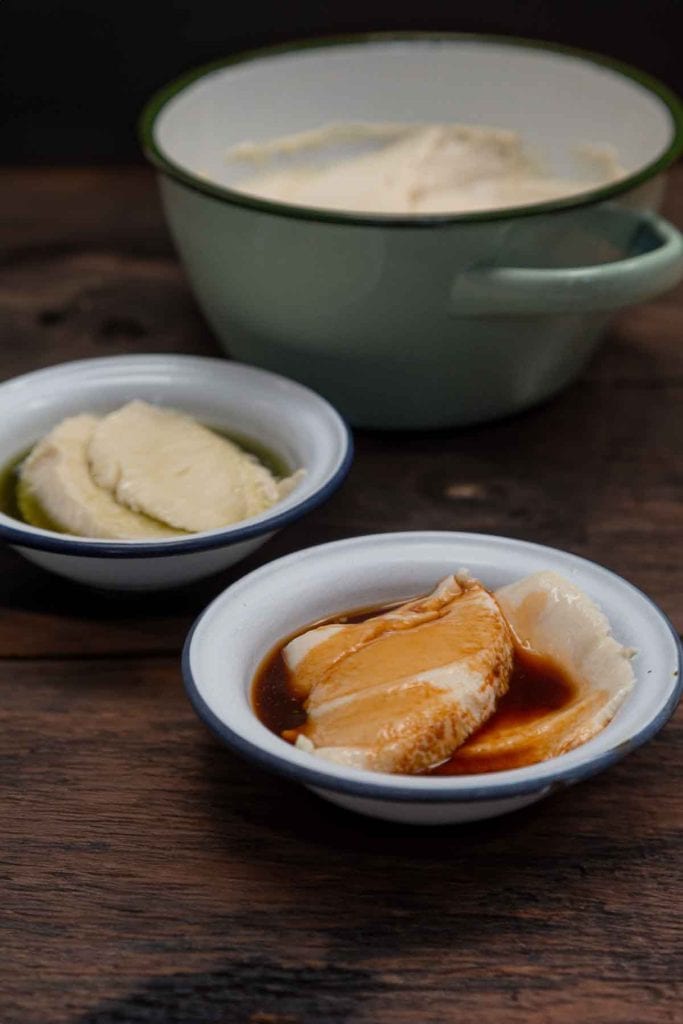
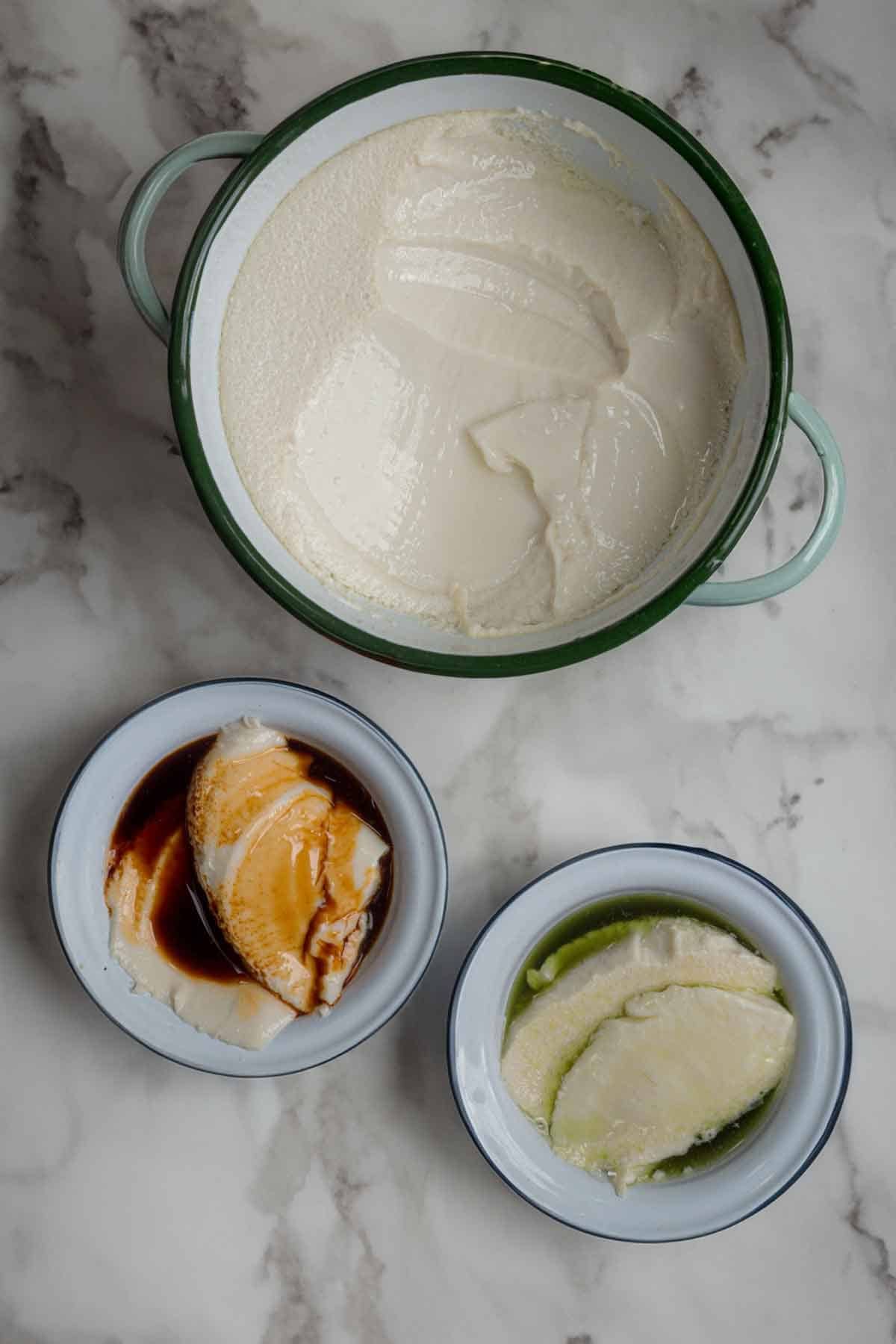
If you fancy the traditional ginger syrup (tao huay nam king เต้าฮวยน้ำขิง) then switch tabs to your favourite search engine and you'll find plenty of recipes.
Method and ingredients
There are many ways to make tofu pudding from fresh soy milk, including pouring the hot milk directly into a bowl with the coagulant to set. I opt for the steaming method because by the time the heated soy mixture is cool enough to strain, it's too cool for that method.
While my prefered coagulant for daohua is gypsum, glucona delta lactone (GDL) and nigari can also be used. The main reasons I use gypsum are because of both habit and convenience. It's what I learned to make tofu with years ago, so it's always in my cupboard. Plus it's cheap and available at larger Chinese supermarkets in London.
Fresh tofu is its own gift, but when you make it yourself you're extra fortunate because the leftover soy pulp, also called okara, is a fabulous ingredient. I've got a few okara recipes up, but I also often layer it in with lasagna or use it in ravioli (especially with pumpkin).
I'm a huge fan of mesh filter bags designed for making soy milk. You can buy them from Aliexpress (and other places too, I'm sure).
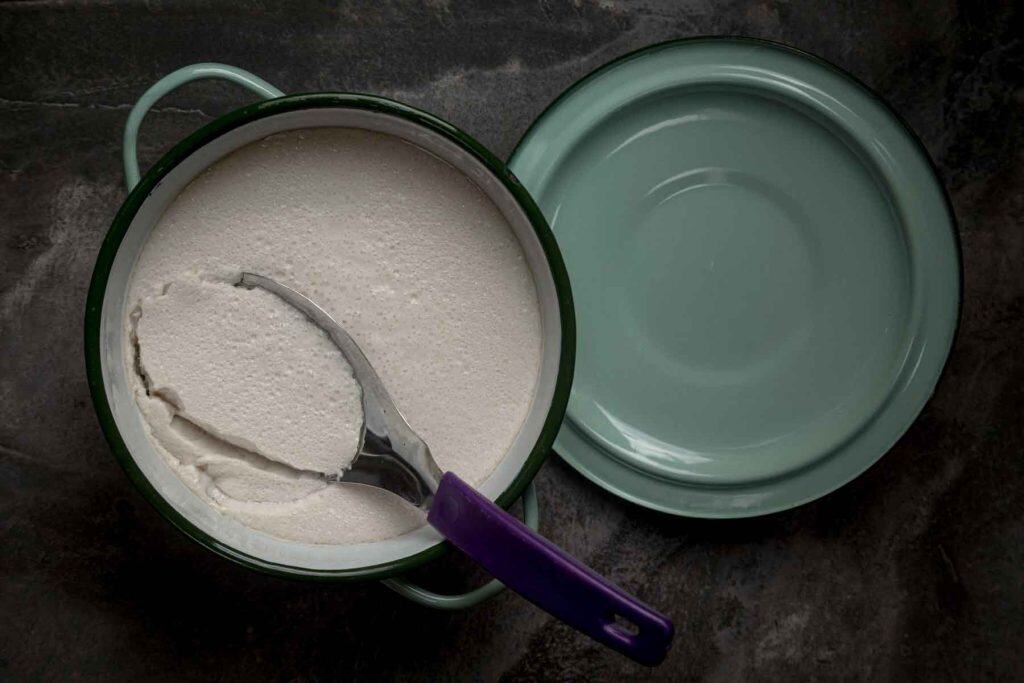
Toppings for douhua, or free form tofu, can be as maximalist or simple as you wish, either sweet or savoury. In addition to the recipes for pandan and Thai tea syrups at the end of this post, here are some other tofu pudding toppings I love:
- Magnolia syrup (made from magnolia blossoms during that brief window of the year when the magnolias are out in bloom)
- Chilli oil, black vinegar (Chinkiang or Baoning), soy sauce, a wee bit of sugar, spring onions, pickled mustard greens, peanuts
- For sweet variations you can try toppings like tapioca pearls, sweet beans, job's tears, grass jelly, fermented sweet glutinous rice, mung beans, taro/sweet potato balls, crunchy fried dough, and whatever else your brain thinks is a good idea.
- Crunchy fried beans are excellent with savoury variants of douhua. Ditto pickles, fresh herbs like Chinese chives and coriander, toasted nori, chillies, sesame oil, toasted ground sichuan peppercorns... you get the idea.
Tao huay (douhua) with Thai tea and pandan syrups
Ingredients
Soy milk
- 150 grams dried soybeans
- 850 grams water
- ½ tablespoon powdered gypsum
Pandan syrup
- 160 millilitres water
- 75 grams pandan leaves shipped into approximate 1 centimetre segments
- white sugar see instructions for quantity
Thai tea syrup
- 2 tablespoons Thai tea
- 100 millilitres boiling water
- 85 grams brown sugar about ½ packed cup
- pinch salt
Instructions
Make the soy milk and tofu
- Soak the soybeans in plenty of water the night before you plan to make tofu. The next day, drain the beans and add to a blender with about 700 grams of the 850 grams of water (you can eyeball it; no need to be precise). Turn your blender up to the highest speed and leave running until the soybeans have broken down into a pulpy liquid. Pour into a saucepan. Use the remaining water to rinse the soy dregs from the blender jug and add this to the saucepan as well.
- Turn the heat on the hob to medium and cook, stirring regularly to prevent burning, until the raw beany aroma has dissipated. When you taste it, there should be no bitterness. Turn off the heat.
- There are two options for straining. One is to line a sieve with a large square of muslin cloth, through which you'll pour the contents of the pot. Bundle up the corners and squeeze until you've got as much liquid out as possible. The other option, which is my preference, is to use a mesh filter bag designed precisely for this job. Pour the contents in the bag, cinch it at the opening, and squeeze until you've got around 700 millilitres of fresh soy milk. Whichever method you use, you'll probably have to leave the mixture to cool slightly before you can squeeze with your hands. And yes, your hands will be tired from squeezing.
- Leave the soy milk to cool completely and don't discard the pulp, which you can repurpose in okara recipes.
- When the soy milk is cooled, set a steamer going at a steady, vigorous simmer. Find a large heatproof bowl or multiple bowls that will fit inside.
- Whisk the gypsum through the soy milk and pour into your containers. Cover them, whether with a lid or cling film, and place them in the steamer. Steam for 15-20 minutes, until the tofu is jiggly but set. It will firm up as it cools. When the tofu has cooled, place the container(s) housing the tofu into the fridge.
Pandan syrup
- Combine the water and pandan leaves in a blender and liquidise until you've got a grassy smoothie. Pop a mesh sieve over a small saucepan and tip the contents in. Squeeze, either with your hands or a silicone spatula, through the sieve. You should get somewhere in the vicinity of 190 millilitres pandan water.
- Measure the same amount of sugar by volume (e.g. if you have ¾ cup pandan water, use ¾ cup sugar). Add to the saucepan with the strained pandan water and heat until the sugar is dissolved. Leave to cool and then refrigerate.
Thai tea syrup
- Add the Thai tea to a heatproof bowl and pour the boiling water over. Leave to steep for 5 minutes. Grab your mesh sieve again and place it over a small saucepan. Pour Thai tea contents into the sieve and press with a silicone spatula to extract as much water as you can.
- Add the brown sugar and salt to the saucepan and heat until the sugar is dissolved. Again, leave to cool completely and then refrigerate.
To serve
- If you've steamed your tofu pudding in one large vessel, use a large serving spoon to scoop out servings into smaller bowls and top with a few tablespoons of one of the syrups. If you've used smaller bowls, add the syrup directly to those. Remember, you can always add more syrup if you want a sweeter tofu.
Leave a Reply