
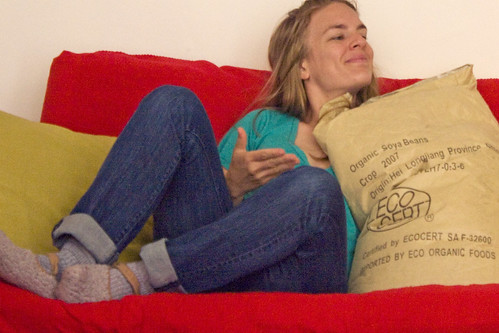
Many of my readers are aware I make 99% of all tofu I use, and much of the soy milk I consume as well. I store massive quantities of soy beans under the sofa so I can enjoy some of my favourite foods cheaply and conveniently (really, making tofu is so much less complicated than it sounds).
Anyhow, below is a quick run down of my main uses for the prolific soya bean, complete with numbered pictures (hey, I love pictures).
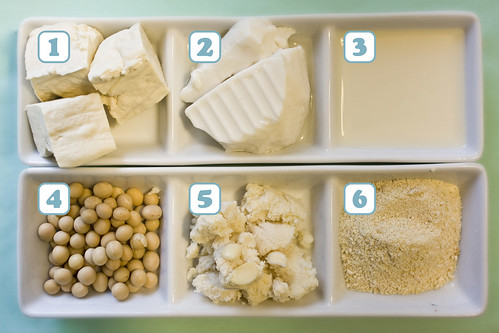
1. Firm tofu coagulated with nigari and gypsum
Nigari coagulated tofu has by far the best flavour, but gypsum bulks it up a bit, so I tend to use a combination of the two in the process. I use a homemade tofu press crafted by my father, draining and lightly pressing the curd for up to an hour before removing the block, wrapping it in a tea towel, and popping it in the fridge.
If I want a more firm tofu, I press it further using the usual techniques. I use fresh tofu fairly quickly, so I tend to skip the step of storing it in water in a closed container (but I will store it this way if it's going to be around for a few days).
2. Silken tofu coagulated with nigari
This is tofu which hasn't been pressed, and the nigari imparts a lovely sweet taste which makes it ideal for simple pudding dishes and in light soups.
3. Soy milk
I make my soy milk with approximately 1.5 litres (6 cups) of water per 190g (1 cup) of soy beans (dried weight), or a water to bean ratio of 6:1. This makes a very thick and creamy soy milk which yields more tofu with less liquid (for those who use a soyquick machine, that's two lots of bean per one lot of water).
4. Dried soy beans
This is the base product, dried and waiting to be transformed into soy milk. Pre-soaked they're quite small, but increase in size by about a third or half when soaked overnight. Once soaked, they are ground with water and strained. What comes out of the stainer is soy milk.
5. Fresh okara
What's left behind in the straining process is okara, or soy pulp, a highly nutritious source of fibre which can be used in a whole range of dishes. If you look closely, you'll see some whole soy beans in there, to give an idea of what they look like once soaked.
6. Dried okara
And finally I'm often left with heaping quantities of okara, hence I dry it in the oven so it keeps. It can be reconstituted later and/or added to baked goods.


MissCindel says
Thank you for posting this! I was confused at first because Texan friends of mine had told me their well contained Gypsum which made the water dangerous to drink. So I went searching for more info and learned that there is a food-grade Gypsum.
I love to learn new information, especially if it contributes to my food-allergy conscious existence in the kitchen :*)You Rock!!
Kip says
Thanks! Gypsum is used in the beer making process too, I think (I see it available in beer making sections in cook shops). Maybe it's just one of those things that becomes dangerous in high quantities?
DBarr says
DRYING the Okara? THANK you! This batch is going into the little stove on top of the woodstove, then. I never throw away the Okara, but some recipes aren't so successful. THANK you for this great page!
Kip says
It's a great way to save on waste since it goes off fairly quickly if just kept in the fridge!
Bess Hobson says
Love your idea about storing soy beans under the couch!
Kip says
Thanks! Got to make due with limited space somehow...
Kristina says
I make my own firm tofu. I’d love to make silken but all the recipes I can find include gypsum. I only use nigari to make my tofu and I’d rather not have another ingredient on hand for something I’d only make a handful of times a year. Would you mind sharing how you make your silken tofu? Thanks!
Kip says
Hi Kristina, I've sent you an email (which you know!) with some thoughts.
Emma says
Hi! How can you get rid of that soy milk beany taste? I tried everything, soaking in hot water, steaming, removing the skins, and all of this separate and at the same time, still has that taste I cannot stand.
I use a soyabella machine (just for reference) Any tips will be greatly appreciated!
Thank you!
Kip says
Hi Emma,
If the beans are cooked sufficiently then the bitter aspect of the beany taste should be cooked out. Maybe you could try make soymilk on the stovetop just to see if your results are different? Or, perhaps to start, heat the milk made from your machine on the stove for 15 mins or so (stir regularly). If they aren't and you still don't like it, I would wager you just don't like the flavour of soy (which is fine). Most commercial soy milks purchased in the West tone down the soy notes by use of flavourings, which means when we make soy milk at home it doesn't taste like the stuff we're used to buying from shops. I believe this has skewed our concept of what soy tastes like.
I reserve the right to improve malicious and trollish comments.