
Jump to:

Tom yum soup (or tom yam, depending on your transliteration) is likely a familiar dish to many of you, one that appears on the menu of every Thai restaurant outside the kingdom.
"Do you have a good recipe for vegan tom yum soup?" is an oft asked question by friends, readers of this blog, and Instagram followers. I anticipate this particular request, and how to respond, with hesitation. For a dish which, at its most basic, is little more than an infusion of lemongrass, galangal and makrut lime leaf, seasoned with chillies, fish or soy sauce and a souring agent, there is challenge in its simplicity.
More a method than a rigid formula, tom yum comes in a variety of expressions. And that's not even touching on the many opinions that are as brightly seasoned as the soup itself. Tom yum paste or fresh aromatics? Should you use nam prik pao aka chilli jam? What about coconut milk? Evaporated milk? Lime or tamarind? Rigid claims of so-called authenticity go head to head with modern preferences and nostalgia. Are we to focus on the recipes penned by royalty in the 20th century, the flourishing contemporary preparations, or those made by relatives loved and lost?
When folks ask that difficult question of how to make good vegan tom yum, what they are usually asking is "how can I make restaurant quality tom yum at home?" Hence while there are many variations in play across Thailand, I will focus on the one that pervades most restaurant menus abroad.
Characteristics of authentic tom yam
We convince ourselves, rightfully or otherwise, we are conversant in some food cultures but not others. Following on from this, we accept a multitude of variants of a given dish within that culture. Take Italy and pizza (and pasta), for instance. These foods have been deconstructed and rebuilt with abandon. To non-Italians, we are not breaking any rules to do with it what we want and to globally claim it as our own. On the other hand we are determined to condense specific dishes from other cultures into a single representative "authentic" version. Reading through dozens of different recipes in Thai and English, I find there are as many variations on tom yam as there are cooks behind them. Why should there be a single authentic version of this Thai soup when are confident in putting pineapple on pizza?
And so when I use a descriptor like authentic, I mean it more in the sense of this will be a flavour profile you recognise as being familiarly Thai rather than as a judgement on inevitable change to cultural artifacts like food.
We already know tom yum as a hot and sour soup, but beyond the spicy heat and acidity is an additional strong dimension of saltiness. Further ingredients and seasonings layer added complexity. Nam prik pao, for instance, imparts a toasty sweet and sour element while imbuing the surface with a doppled orange appearance. Combine that chilli jam with coconut or evaporated milk, a trend that began in Bangkok in the 1980s, for added richness. Tom yum with chilli jam will often, but not always (as in this recipe), have milk as well (clear tom yam without milk is called tom yum nam sai whereas tom yum with milk is called tom yum nam kon).
Preparations can vary regionally as well. For instance I have seen Northern and Southern recipes for tom yum with the inclusion of turmeric (and I highly recommend this as an ingredient).
Jump to RecipeTom yum history
In the historical culinary landscape of Thailand, infusions came before stocks (which arrived with later Chinese migration). Thus earlier preparations of tom yum would use water. Today it is not uncommon to see light stocks used as part of the base, and given tom yum is a process of layering flavours I am inclined to use a light stock over water if there is one hanging out in my fridge or freezer.
In its original form, tom yum would have been a clear soup, a simple infusion comprised of the handful of ingredients mentioned earlier. The filler ingredient would have been fish, not shrimp, and of course it is possible today to enjoy animal free variants. Mushrooms are now a popular ingredient. They are a more recent addition but you would be forgiven for not knowing given how frequently fungi accompany tom yum nowadays.
The addition of a couple of key elements that make up the tom yum you order at restaurants - nam prik pao and perhaps coconut milk - were later additions, although less recent than you might assume. The difference between ancient versions and that which is consumed most readily today is the preparation of the chilli jam. The nam prik pao used in early tom yum recipes relied on chargrilling (the word pao refers to this cooking style), but today's versions are typically deep fried.
Making and serving tom yam soup
Years ago my mother complained about a Thai lunch at a local (to her) restaurant she visited with friends. "The soup was inedible," she said, lamenting the not fit to eat aromatic chunks floating in the tom yum she had ordered. Thai people understand the fibrous chunks of galangal and lemongrass, as well as the perfumed makrut lime leaves, are not to be consumed. If you'd rather avoid confusion from dinner guests who aren't in the know, however, it's fine to remove these bits before serving.

While it is perhaps a cliché to state the importance of fresh quality produce to achieve a supreme dish, this is especially true for preparations that rely on in tact volatile essential oils for flavouring. In practice this means juicy and fat lemongrass stalks as well as fresh (or good frozen) lime leaves and galangal. You will not achieve the same flavours using any of these aromatics in their dried forms.
It's important to bash the lemongrass with a pestle or the back of a knife before adding the stalks to your pot. This act bursts the oil glands inside the grass, releasing its essential oils (these oils are what saturate and flavour the water).
The aroma molecules in galangal are strongest when pounded to a paste, an action that frees the most oils. Sliced galangal releases these oils too, but at a slower pace. Some recipes for tom yam suggest bruising the slices while others do not. I opt for the former as it presumably frees some more essential oils before adding this ingredient to the water or stock for infusion.
It's probably now no stretch of the imagination to see why we tear lime leaves (or you can bash them too) before adding them to the pot.

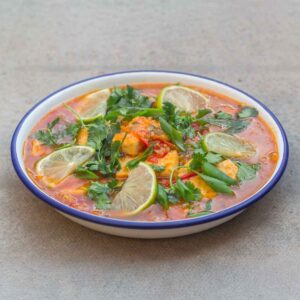
Contrary to Western practice, Thai soups form part of a meal with rice rather than a starter. As you can see in the photo above, the vegan tom yum is surrounded by four or 5 other plates of food, all of which are eaten as a shared meal with rice. For reference, that is a normal sized soup or cereal bowl of soup, and it was shared amongst 3-4 diners. This is typical.

Vegan tom yum soup ต้มยำวีแกน
Ingredients
- 500 millilitres water or unsalted light vegetable stock
- 1 stalk lemongrass (2 if small stems) bashed with a knife or pestle, and sliced sliced into 2 inch lengths
- 4 centimetre piece of galangal cut into thin slices
- 3-4 makrut lime leaves (depending on size) torn
- 3 small shallots peeled and smashed with the back of a knife
- 2 coriander roots lightly bashed
- 0-5 bird's eye chillies (or dried chillies) lightly bruised (or sliced if you want a spicier soup)
- 150-200 grams mixed mushrooms sliced or whole if small
- 6-8 cherry tomatoes halved (optional)
- handful vegan fish balls, tofu puffs, firm tofu, other veg
- 2 tablespoons nam prik pao (Thai chilli jam)
- 2 tablespoons Thai thin soy sauce
- 1-2 teaspoons palm sugar
- ¼-½ teaspoon salt
- 3-4 tablespoons lime juice
- 2 sping onions sliced on the diagonal (optional)
- ¼ cup vegan evaporated milk or coconut milk (optional)
- big handful roughly chopped coriander or sawtooth coriander
Instructions
- Add water (or stock), lemongrass, galangal, lime leaves, shallots, and coriander roots to a pot. Bring to the boil. Knock heat back to a slow simmer for 3-5 minutes.
- Add chillies, mushrooms, cherry tomatoes, tofu (fish balls, veg, etc...) nam prik pao, soy sauce, palm sugar, and salt. Stir through to combine and break up clumps of nam prik pao. Bring back to the boil and simmer for 2 more minutes.
- Turn off heat and add lime juice, spring onions, and vegan evaporated or coconut milk (if using). Garnish with coriander.
- Serve with steamed jasmine rice.
Desicart says
This Recipe is Look So Fresh, Healthy and Delicious to Prepare. Thank You for Sharing this Recipes. So Yummy !!! I Love it. I'll Definitely Try it. Thank You. Photos are Awesome !!!
Kip says
Thanks! I'd love to know what you think after you try it.
Desicart says
Soup was excellent !!! Thanks For Sharing !!!
Simon says
Do i leave all the ingredients in? like coriander root and galangal or do i fish them out after the first boil?
Kip says
Hi Simon, apologies for not responding sooner. The answer to your question is it's up to you. Thais would leave it in, as would I, but a lot of foreigners may wish to remove them before serving. If that's the case, I'd leave them in as long as possible to allow for the most infusion.
I reserve the right to improve malicious and trollish comments.